
Where Moore City Directory Collections Live
There is no verified, continuous annual Moore run in the published branch-library material, so the right first question is which title and year OHS can confirm. The Oklahoma Historical Society annual-directory form accepts a city and year, but says use of the collection requires a visit to its Research Center. Its records guide also points to early census, directory, newspaper, cemetery, and county-land sources. Treat each result as a dated source, not proof that every year or every Moore address survives.
| Collection | Years | Where Held | Access |
|---|---|---|---|
| OHS annual directory collection | Moore years to confirm | OHS Research Center | City-and-year search; visit required |
| Smith First Directory | August 1, 1890 | OHS research collections | Reference inquiry |
| 1890 Territorial Census index | 1890 | OHS research collections | Research Center lead |
| Moore Messenger | 1935-1960 title; 1935-1944 online subset | OHS Gateway | Digitized title and issue search |
| Cleveland County Courier | July 13, 1895 issue verified | OHS Gateway | Digitized page images |
Moore Public Library is a useful nearby reference stop at 225 S Howard Ave. Ask staff to confirm a title, year, reverse volume, obituary index, yearbook, microfilm reel, or vertical-file item before making a trip. Pioneer Library System lists research databases, but its public branch page does not establish a year-by-year directory shelf.
Before requesting a volume, write down the person’s full name, alternate spellings, a likely street or community, and the year range. Ask whether the record is a name list, a street-order volume, a newspaper reel, or a catalog description. That small check matters because OHS, the public library, and a county-history lead can all be useful without holding the same material or offering the same access method.
OHS City Directory Search for Moore
The OHS annual-directory search has simple City and Year fields. Use Moore first, then try Norman or Cleveland County only as a broader holding check, and write down the exact query used. If a search result is unclear, OHS reference staff can clarify whether it describes an annual volume, a catalog entry, or a collection that must be consulted on site. The OHS records guide names Ancestry Library Edition and HeritageQuest as Research Center tools, while Pioneer Library System advertises Ancestry Library Edition as another local research route.
Start at the Oklahoma Historical Society records guide for the broader collection map.
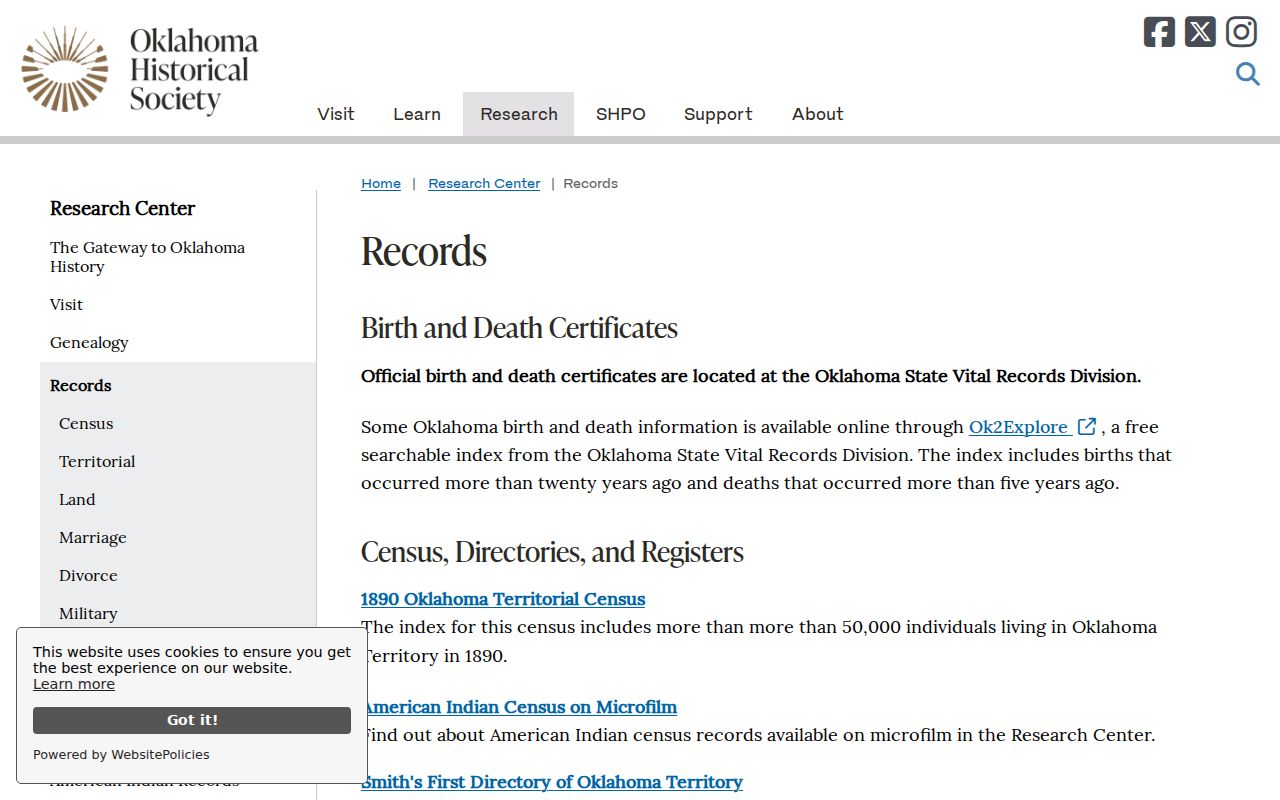
The guide places a directory check beside census, newspaper, cemetery, and land-record research, which is useful when a single volume does not settle a name or address.
Moore Messenger Beside City Directories
The Moore Messenger title collection is a strong companion to a directory search. OHS identifies the title as a 1935-1960 publication with 144 issues and 1,213 pages, while the digitized run shown begins in December 1935 and reaches May 1944. Search the newspaper by full text, metadata, title, subject, creator, name, or proximity. A notice can supply a spelling, organization, event, or date to test against a separate directory or land record, but it is not a substitute for a verified household listing.
This OHS directory search screen shows the city-and-year route used to locate annual volumes.
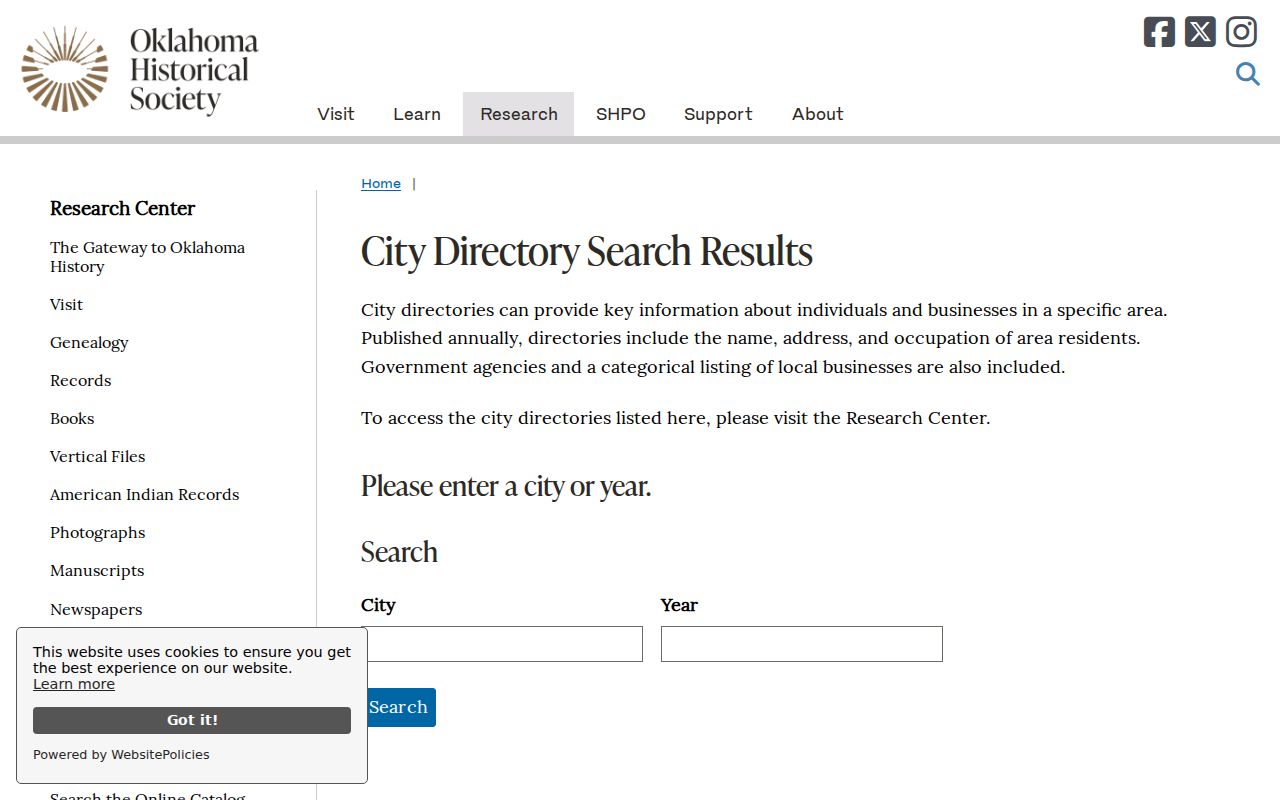
Keep newspaper hits and volume results on separate lines in a research log, then compare their dates rather than merging them into one claim.
OHS's broader newspaper collection began in 1893 and includes roughly 4,000 titles, more than 42,000 microfilm reels, and material spanning 1844 to the present. The Research Center's newspapers are noncirculating and do not go out through interlibrary loan. Its obituary index to The Oklahoman can provide a lead, but a listed obituary copy fee or a digitization estimate applies only when OHS confirms the exact material and service requested.
How Moore City Directory Entries Read
No sample Moore annual entry was verified in the research material, so do not assume every volume uses the same marks or fields. The OHS description says annual directories can contain resident names, addresses, government agencies, and categorized businesses. Photograph or transcribe the title page, year, publisher statement if present, and abbreviation key before copying a name. That gives later researchers a way to check the original entry instead of relying on a shortened note.
| Directory year | Places the entry within the publication's own coverage date. |
|---|---|
| Name spelling | Preserve initials, suffixes, and alternate spellings exactly as printed. |
| Street address | Copy directional prefixes, street suffixes, and any unit or lot detail. |
| Category detail | Note any agency, business classification, or other label the volume actually prints. |
| Page reference | Lets another reader return to the title, page image, and surrounding entries. |
- Criss-cross directory
- A volume arranged by street and address rather than by name. Confirm that OHS or a library actually holds one for the desired year.
- Householder index
- A name-oriented index that can point from a person to a listed address or page.
- Abbreviation key
- The volume's explanation of its shortened labels. Copy it with the entry because meanings vary by publisher and era.
Moore's 1890 Directory Leads
For the territorial period, OHS identifies both the 1890 Territorial Census index and the Smith First Directory dated August 1, 1890. Cleveland County was organized in 1890, and Moore's early development followed the Southern Kansas Railway before the city incorporated in 1893. These sources are better starting points for an early local name than trying to force a later municipal listing backward. Pair them with county deed books and the early newspaper record, and label the result as a county or territorial lead where the source does not name a Moore street address.
The OHS Cleveland County historical search supplies a county-history lead, including the Moore-Lindsay House context in Norman.
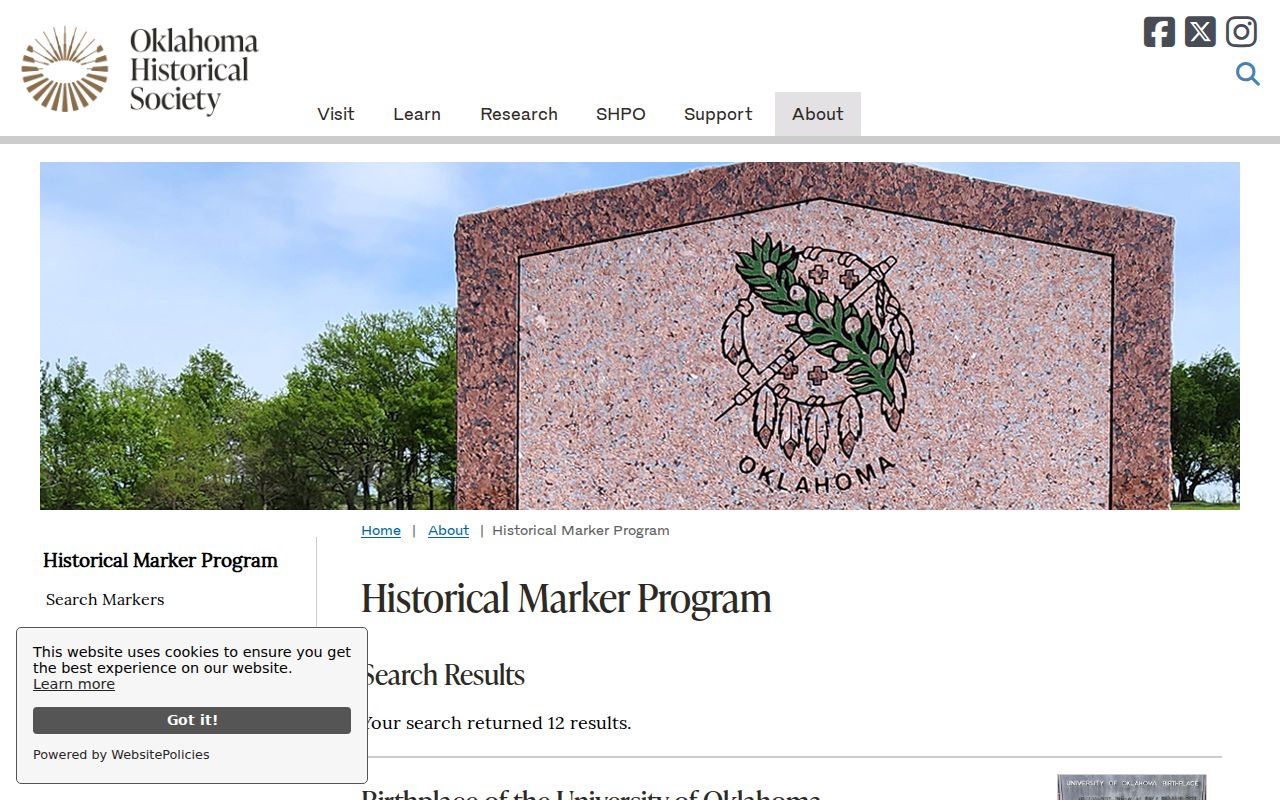
Use that lead to identify local-history contacts, but confirm current holdings, access hours, and reproduction options directly before relying on them.
Moore grew along the Southern Kansas Railway in 1886-87, was associated first with the name Verbeck, and incorporated in 1893. That chronology explains why a territorial census, first directory, county land record, or early Courier issue may be a better fit than a later city-centered source. The research question should follow the date of the evidence, not the modern label placed on the place.
Moore City Directory Gaps
It is a mistake to read an online search box as evidence of an unbroken Moore directory sequence. The verified OHS materials do not publish a complete Moore run, and the Moore Public Library page does not list a directory or obituary inventory by year. Ask a precise question: “Do you hold a Moore, Norman, or Cleveland County directory for this year, and is there a street-order volume?” If the answer is no, move sideways to newspapers, territorial sources, cemetery records, or the County Clerk's land records rather than filling the gap with an assumption.
Moore Directories and Sanborn Context
OHS Sanborn and Clarkson map access can add the built context around a historic address. A map may show a structure, nearby business, street layout, or block pattern even where no resident name appears. Check the map's actual year and the city coverage before drawing a conclusion. Moore's grid also relies on NW, NE, SW, and SE prefixes, so retain the directional part of an address when comparing an old listing to a plat, map, or later parcel record.
For example, “19th” without its directional prefix is not a complete Moore address key. Compare the printed address with its street suffix, subdivision or plat language, and map date before connecting it to another record. An old map can illuminate a street setting, but it cannot fill a missing listing or settle a name by itself.
Trace Moore City Directories Through Time
A household trail works best as a dated sequence. Start with the earliest verified listing, then move forward only when another volume or supporting source is available. The record history changes across eras: territorial materials help with the beginning, newspapers can bridge later periods, and county land records provide a distinct property layer. A name leaving a volume may reflect a move, a changed spelling, a missing year, or an editorial choice, so look for corroboration before deciding why the entry disappears.
- Record the first verified name, address, year, title, and page.
- Check the next available directory year and note every changed element.
- Use a street-order volume only if its holding and year are confirmed.
- Pair a directory-era clue with the relevant census, newspaper, or county-land source.
- Keep direct entries separate from reasonable but unproven connections.
For a property-centered question, the Moore past residents guide explains how a directory clue can be tested against a deed chain without treating an occupant and a recorded owner as the same person.
When a name disappears, test several possibilities in order: a move, a spelling change, a gap in the available run, a death notice, or a different household arrangement. The OHS newspaper tools support name and proximity searching, while cemetery and county-land records offer separate dated checks. A missing entry should remain a missing entry until another source explains it.
Moore Cemetery Records After Directories
When a historical trail reaches an end, Moore and Smith Cemetery records may offer another dated source. The City Clerk maintains lot deeds, interment records, and related cemetery material, while no public online name index was verified. A focused request with a full name, approximate dates, and cemetery is more useful than a broad name-only inquiry. Record the cemetery, section or lot if provided, interment date, and whether the result comes from the maintained register or a later transcription.
The city says both cemeteries are more than a century old, with some graves dating to the 1800s. That makes the Clerk route particularly useful for early family-history research, but it also means that the date and provenance of each result matter. A lot deed, a maintained interment record, and a later transcription should be identified as different kinds of evidence.