
Moore Resident Lookup Source Routes
To look up a resident in Moore, match each question to the custodian that keeps the record. The Cleveland County Assessor's Spatialest property search is a strong first stop for a current parcel, owner display, mailing address, legal description, sales, values, and map detail. It is not proof that every person tied to a parcel lives there. The County Clerk's recorded-land index, the court docket, and the state voter and vital systems each answer narrower questions.
| Record | What It Confirms | Where | Access |
|---|---|---|---|
| Parcel record | Current owner display, situs or mailing address, legal description, sales | Cleveland County Assessor Spatialest | Online search |
| Recorded land instrument | Named party role, instrument date, legal description, book or page when shown | Cleveland County CoGov | Online index, office copies for the record |
| District-court docket | Case number, parties, filings, hearings, and public disposition entries | OSCN | Online discovery, Clerk copy when needed |
| Registration verification | An individual registration result through the permitted portal | OK Voter Portal | Name and date-of-birth verification |
| Birth or death index | Spelling, event, approximate date, or county lead | OK2Explore | Free index, controlled certificate access |
A name alone is rarely enough for a reliable one-person record check. Preserve the record date and whether the person is identified as owner, party, grantor, grantee, or another role. A current owner, a taxpayer, and a historical occupant can be different people. For a block-wide address task, the Moore by-street directory keeps the parcel sequence in view without turning a single name query into a broad roster.
Moore Resident Court Checks
Cleveland County sits in Oklahoma's 21st Judicial District. OSCN is the discovery layer for district-court records, with county, party last, first and middle name, case number, date-of-birth range, party type, case type, and filed or closed date options. A traffic citation number has its own route. Results can show parties, attorneys, hearings, counts or issues, dispositions, and docket events. A match should be compared with the county, approximate date, address context, and case type before it is treated as a lead for the same person.
| Field Label | Type | Required | Options or Format Notes |
|---|---|---|---|
| County | Selection | No stated requirement | Limit the search to Cleveland County before reviewing a party result. |
| Party last, first, middle name | Text | No stated requirement | Test middle initials, suffixes, former names, and reasonable spelling variants separately. |
| Case number | Text | No stated requirement | Best when a number is already known from a notice or another official record. |
| Date-of-birth range | Date range | No stated requirement | Use as a second identifier for a common name. |
| Party or case type; filed or closed dates | Selection and date range | No stated requirement | Narrow the result set before comparing parties, hearings, and docket events. |
The OSCN court-search interface is shown below. It is useful for testing a carefully narrowed name, but the local rules say online dockets should be checked against the court because a posting may be incomplete or a hearing detail may change.
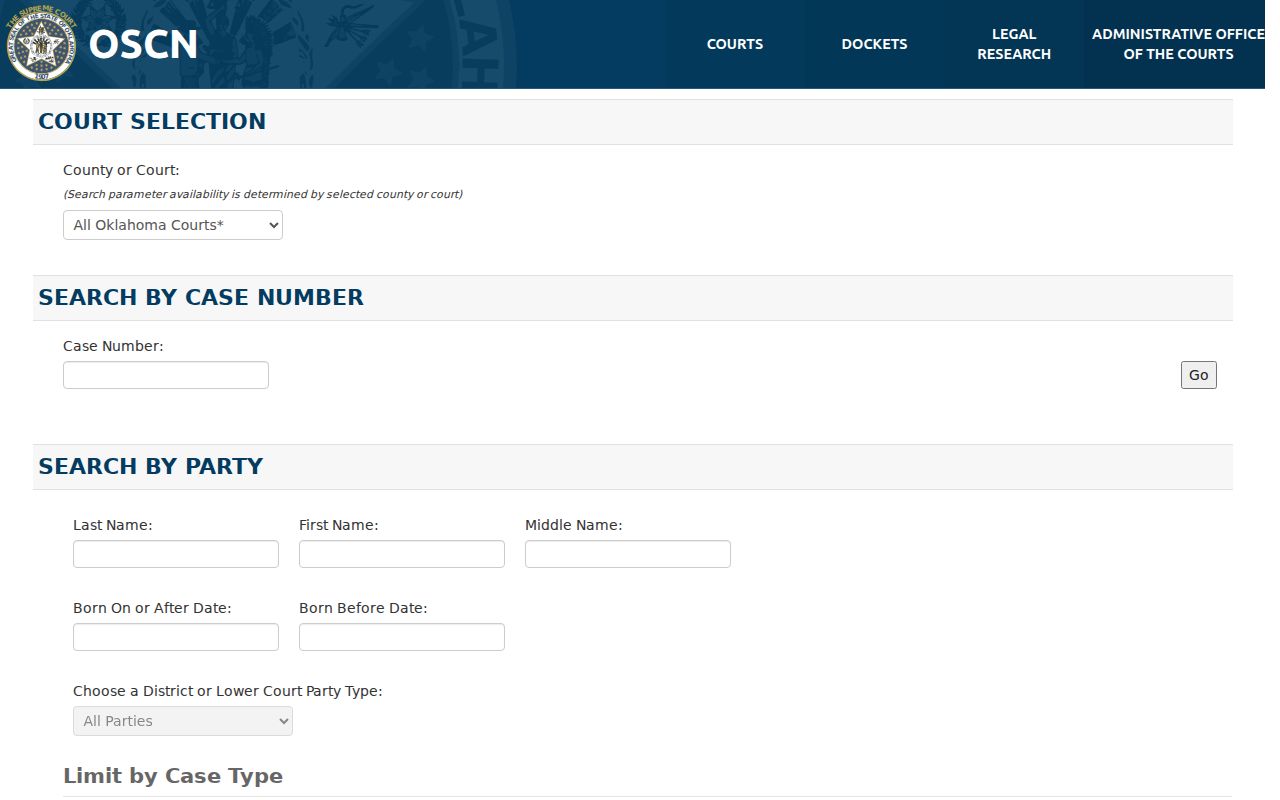
Use the screen as a starting point, then request the particular document from the custodian when the result matters. The Cleveland County Court Clerk request route accepts the case type, party names and aliases, approximate year, document title or date, and delivery details. In-person service is described as the fastest option; mail and the listed Clerk email are additional channels, while certified documents are not emailed.
Note: A filing is not a finding, and a public docket entry is not proof of every fact suggested by a similar name.
Moore Resident Voter Checks
The OK Voter Portal is for individual verification, not anonymous enumeration. It requires the first name, last name, and date of birth as shown on registration, and some services may ask for more verification. Its tools include registration, address or mailing changes, party changes, sample ballot, polling place, districts, early voting, replacement voter-ID card, and a downloadable verification form. A voter record can be one corroborating point only when the portal's required details are properly supplied.
The official voter portal presents the individual path used for one-person verification. Public voter information may include registration and mailing address, party, status, voter ID, precinct, districts, registration date, and election history or method, but phone numbers are not a required registration field. State identification numbers and Social Security numbers are confidential.
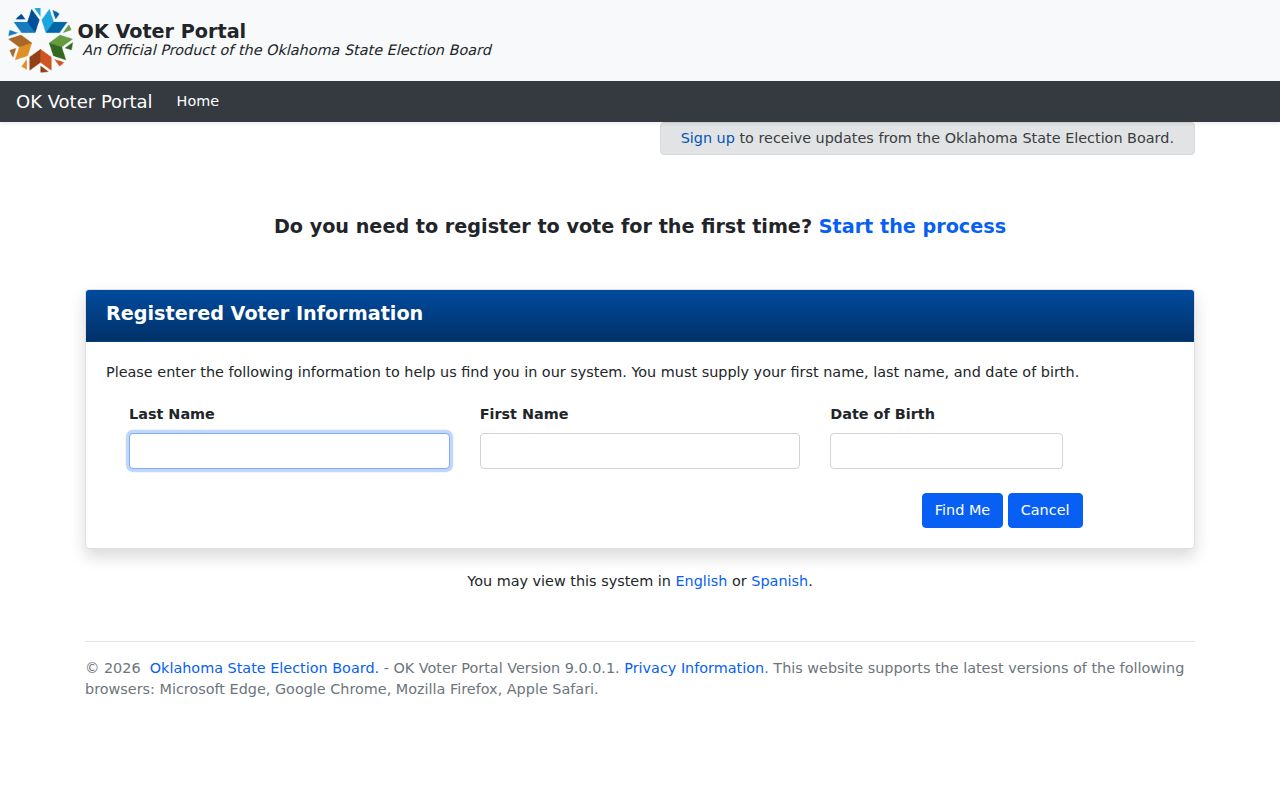
The image shows why the needed personal inputs should be used only for the person-specific check. An eligible requester who needs a voter-registration list must use the Election Data Warehouse request process, including its notarized form and use attestation. The Election Board data notice explains the public and confidential field boundaries.
Verify a Moore Resident Record
Verification means connecting independent records without blending their roles. Start with the best identifier available and add a second source that has a different keeper. For a common name, two of these details should line up before treating the result as a solid match: county, street address, age or date, spouse or relative, attorney, legal description, ward, or local newspaper context. Middle initials, suffixes, former names, and alternate spellings deserve separate searches.
- Search Spatialest by owner or property address. Record the parcel or account, legal description, situs address, mailing address, and last sale information separately.
- Use the parcel detail to search the CoGov land index by the relevant party, subdivision, lot and block, or a narrow date range. Label the recorded role, such as grantor or grantee.
- Run the name and its reasonable variants in OSCN, then compare jurisdiction, year, case type, and other available identifiers rather than relying on the name alone.
- Where permitted, use the voter portal or an historical index as a second check. Request an ordinary or certified copy from the responsible custodian only when the needed record is available to the requester.
- Docket
- A court's running list of events, filings, hearings, and entries in a case. It is a case trail, not automatically the full document file.
- Index and image
- An index is a searchable list of record details. An image is the scanned instrument or document itself, and it may have different access or copy rules.
- Certified copy
- A copy issued or authenticated by the custodian for an official purpose. It is different from a screen result or ordinary copy.
Moore Vital Index Leads
OK2Explore can test a name, event type, event date, and county before a certificate request is considered. Oklahoma began filing births and deaths in October 1908, required filing in 1917, and records before 1940 can be inconsistent. The free index and a certificate follow different access rules. Birth index entries are generally available after 20 years and death entries after 5 years, while a birth certificate opens after 125 years and a death certificate after 50 years.
The OSDH Vital Records guidance describes eligibility, proof, fees, mail processing, and will-call options. Newer records require an eligible applicant or another authorized basis. For a Cleveland County marriage license or divorce file, begin with the Court Clerk rather than treating the state vital office as a substitute. These records are best used to resolve a date, spelling, or relationship question that the parcel and court sources cannot settle.
Moore Resident Evidence Levels
A useful one-person record has a confidence label. A direct result names the person and an address or date. A corroborated result has two independent official or historical sources that align. An inferential result uses geography, household context, a business reference, or a newspaper mention without directly stating the connection. Keeping those labels separate is especially important where Moore mailing names cross city limits or a parcel has a different mailing and situs address.
| Parties and role | Names connected to the case and their displayed party relationship. |
|---|---|
| Case number and type | The court identifier and category used to distinguish one matter from another. |
| Filed or closed date | The time layer needed to compare the result with an address or other record. |
| Attorney or hearing | Context that can separate people with the same name, without proving identity alone. |
| Docket event or disposition | A public event or outcome entry that must be checked with the Court Clerk if a copy is needed. |
Save the source title, URL, and access date with the small evidence row. This makes a later correction possible if a parcel owner changes or a court entry is updated. A historical Moore connection can also be checked against the digitized Moore Messenger or OHS collections, while the record should remain a lead until its date and identity align.
Moore Credential Role Checks
State business and credential records can clarify a named role, but they do not prove a person lives at the listed address. The Oklahoma Secretary of State entity search can show a correct entity name, status, registered agent, office address, registration date, authorized capital, and domicile. Compare those fields to the parcel and a date, not to an assumption about residence.
Oklahoma uses board-specific credential searches rather than one universal system. The state license and renewal directory points to individual boards. An official result can be useful for status, issue or expiration, credential number when public, and a named holder or entity. Moore city-issued permissions follow a different route: the City Clerk or a targeted Open Records request can be asked for a category, date range, and address, because no person-name search was verified on the visible city pages.
Note: A registered office, license address, mailing address, and parcel situs each describe a different record relationship.
Privacy Limits for Moore Resident Lookup
Oklahoma's Open Records Act, 51 O.S. §§24A.1 et seq., opens existing public records subject to exceptions. A public index may still carry redacted fields, a fee, or a limited delivery method. Court matters can be sealed, expunged, juvenile, confidential, or attached to protected material. The voter system excludes state identification and Social Security numbers, and phone numbers are not maintained as a required voter field. A no-result should never be treated as proof that someone has no record.
The Oklahoma voter privacy programs include restricted records and the Address Confidentiality Program. ACP participants can use a substitute mailing address and qualifying voters can have real address information omitted from the public voter list. For a correction, suppression, sealing, expungement, or redaction question, contact the source custodian rather than trying to alter a displayed result.
Lawful use. Moore record checks are for personal, lawful research, family history, civic curiosity, or confirming a record with its custodian. Do not use any result to stalk, harass, intimidate, or harm another person.
Moore Record Request Follow-Up
When an online index stops short, route the request to the office that owns the record. The County Clerk holds land instruments and county open-record routing; the Court Clerk supplies court copies; the Assessor keeps valuation and parcel material; the Election Board handles election records; and Moore keeps city permit and municipal materials. State the record series, name or parcel, beginning and end dates, delivery preference, and whether an ordinary or certified copy is needed. Ask for a cost estimate before requesting a large image set.
For a municipal ordinance or traffic matter, Moore Municipal Court is separate from the district-court system and no reliable online defendant-name search was verified. A court request form, office visit, mail request, or the custodian's stated contact path is a better fallback than assuming a statewide result is complete. For older land research, the County Clerk retains older grantor and grantee indices that extend beyond the online window.